
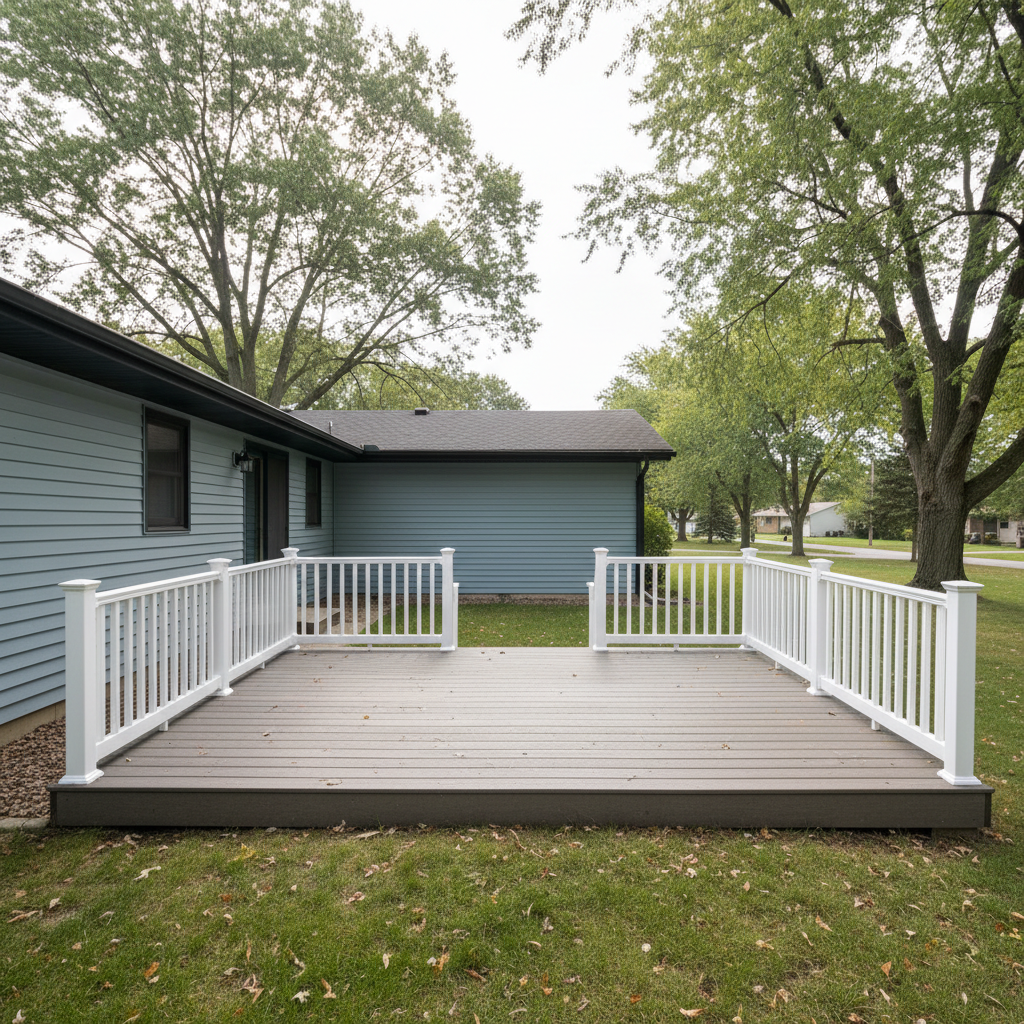
Most people start shopping for a deck builder by asking about wood versus composite, or how much a 300 square foot deck runs. Those are fine questions. They're not the ones that tell you whether the person standing in your backyard knows what they're doing. The real test is what they say about what's under the deck, not on top of it.
Start with the footings, not the decking boards
In southeastern Wisconsin, frost depth runs around 42 inches. That means any footing holding up your deck needs to go below that line, or the ground will heave it every winter and drop it every spring thaw. A builder who's done this in Wauwatosa for any length of time will tell you this number without being asked. If someone quotes a deck and never mentions footing depth, or says 12-inch footings are fine because "that's what the last guy did," that's a walk-away moment. Wauwatosa's glacial till soil is dense and clay-heavy in a lot of the older neighborhoods, which holds water and makes frost heave worse, not better, than sandy soil would.
Ask what diameter footing they're using and how many. A deck with a dozen widely spaced 8-inch footings is cutting corners compared to one with properly sized footings at the spacing the span tables call for. This is not a place to save money.
The permit should not be optional
The City of Wauwatosa requires a building permit for most attached decks and plenty of freestanding ones, with inspections at the footing stage before anything gets backfilled, and again at framing and final. A contractor who suggests skipping the permit to save time, or who says they'll "just pull it after," is telling you they don't want an inspector looking at their footings. That should worry you more than the permit fee ever would. On corner lots and older East Tosa properties near the Milwaukee border, setbacks can be tighter than people expect, and a quick check against your plat survey before anything gets dug saves a much worse conversation later, like a deck that has to come back in two feet after it's built.
If your neighborhood has an HOA, which is more common in some of the newer subdivisions west of Mayfair than in the older bungalow streets near the Village, get the design approved there too before material shows up.
What a real quote looks like
A quote that just says "build 16x20 deck, composite decking, $14,500" doesn't tell you much. A quote worth signing lists:
- Footing size and depth, and how many
- Beam and joist lumber size, species, and spacing (16 inches on center is standard, some spans call for 12)
- Ledger board attachment, including the flashing detail where it meets the house
- Fastener type, since hot-dip galvanized or stainless hardware matters with treated lumber and matters more with composite
- Decking brand and board width, and whether boards run perpendicular or picture-framed
- Railing style and baluster spacing, which code requires to be no more than 4 inches apart
If a builder can't walk you through this list without pulling out a laptop, they're probably subcontracting the actual building and don't know the details cold.
Ledger boards and flashing are where most failures start
Almost every deck collapse you read about traces back to the ledger board, the piece bolted to the house that the whole structure hangs off. If it's lag-screwed instead of through-bolted, if there's no proper flashing turning water away from the house rim joist, or if it's nailed instead of bolted at all, that deck is a liability waiting on a wet spring. Wisconsin gets its heaviest rain in May and June, and a poorly flashed ledger will rot the band board behind it in a few seasons without anyone seeing it happen until a deck board feels soft underfoot. Ask specifically how the ledger is attached and flashed. A contractor who hesitates on this question hasn't thought about it enough.
Reading the age of your house into the job
A lot of Wauwatosa's housing stock dates to the 1920s through the 1950s, especially the bungalow streets around Hart Park and the Village. Houses from that era often have rim joists and foundations that weren't built with a deck ledger in mind, and sometimes the siding or masonry needs special treatment to flash correctly. Newer construction further west tends to have more standard framing and fewer surprises. Either way, a good builder inspects the house itself before quoting, not just the yard. If someone gives you a firm price over the phone without ever looking at your rim joist or foundation wall, they're guessing.
Questions worth asking before you sign anything
- Who pulls the permit, you or them, and is that cost in the quote
- What happens if the footing inspector finds clay or groundwater at the planned depth
- Are they insured for the work, and can they show proof without you chasing them for it
- Who shows up on install day, the person you're talking to or a crew you've never met
- What's the lead time, since a lot of builders in this area are booked out weeks in spring once the ground thaws
And one blunt one: ask what they won't do. A contractor who says "we don't build decks under 36 inches without a permit even if your neighbor did it that way" is telling you they follow code even when it costs them a sale. That's worth more than any brochure.
What to walk away from
Walk away from a quote with no footing detail. Walk away from anyone who waves off the permit. Walk away from a price that's dramatically lower than two others for the same square footage, same material, same railing, because that gap usually comes out of footing depth, fastener quality, or joist spacing, none of which you can see once the boards are down. And walk away from anyone who can't answer a direct question about how your specific lot, soil, or house will change the build.
Beyond that, a lot of it comes down to fit. Do you like how they communicate, do they return calls, did they actually measure your yard instead of eyeballing it from a photo. Those things matter, but they come after the structural questions, not before them. We've built and repaired decks across Wauwatosa and the towns around it, and the jobs that go wrong later are almost always the ones where someone skipped a step nobody could see on handover day. If you want a second opinion on a quote you've already got, or want to start from scratch, Ashford Deck & Patio is happy to come look at the yard before anything gets priced.