
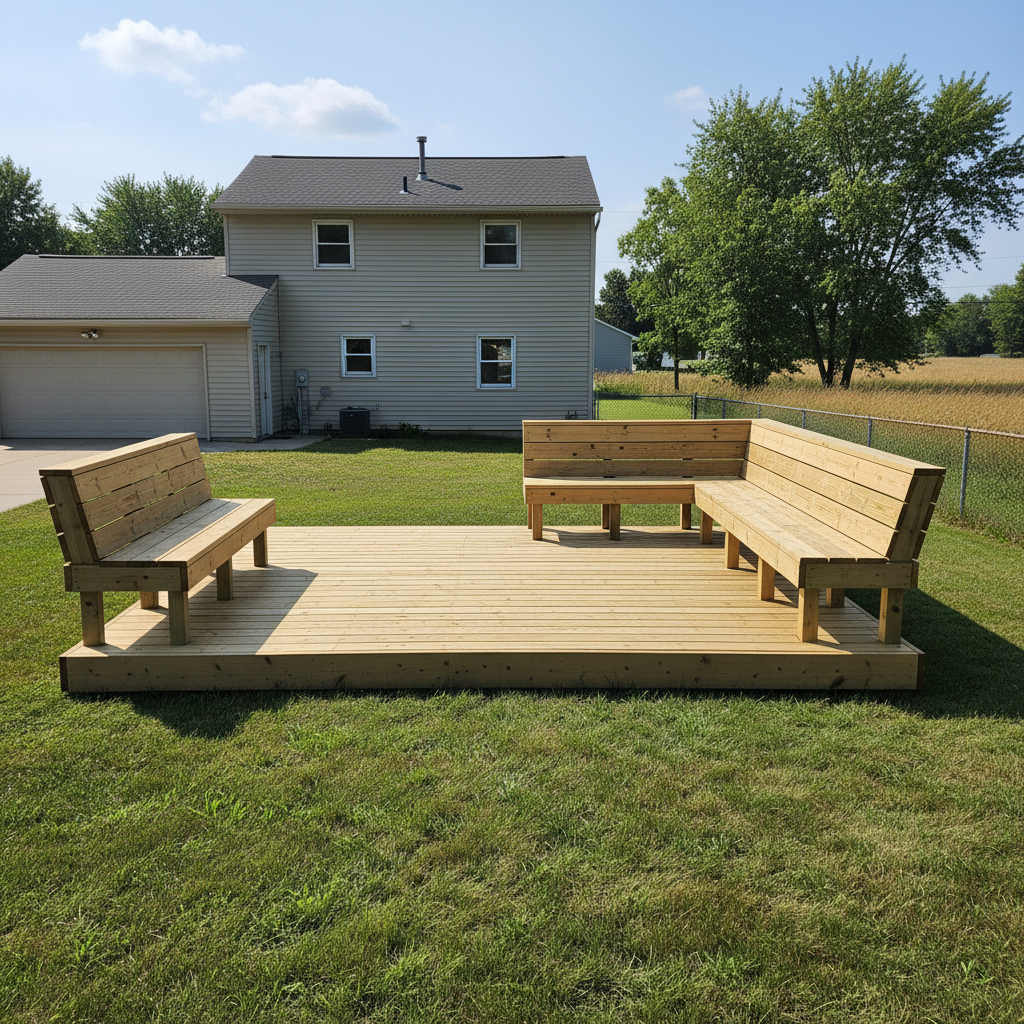
People ask us this constantly, usually in March when they've just noticed their deck boards are still cupped from winter. The honest answer is that "best time" depends on which part of the job you're asking about. Footings, framing, staining, and composite board installation all have different weather windows, and in southeastern Wisconsin those windows don't line up as neatly as a sales brochure would suggest.
Frost depth sets the schedule for anything with footings
Milwaukee County requires deck footings to go down below the frost line, which in this area is 42 inches. That's not a suggestion. A footing poured at 24 inches will heave when the ground freezes and thaws, and over a few winters you'll see a post pull up, a railing go out of plumb, or a ledger board start separating from the house. Digging 42 inches down through Wauwatosa's clay-heavy glacial till is slow work even in good conditions, and it's close to impossible once the ground has frozen solid, usually sometime in December. So any new deck, porch addition, or structural rebuild that needs new footings really has to get dug between April and early November.
Spring looks tempting because everyone wants their deck back after winter, but April and early May here mean saturated clay. A post hole in wet clay doesn't hold its shape, concrete poured into a sloppy hole doesn't cure evenly, and you're fighting mud the whole time. We'd rather dig footings in late May through September when the soil has firmed up, even though that's not the first warm week of the year.
Framing and structural repair don't care much about season, within reason
If the footings are already in and you're replacing joists, sistering a rotted beam, or swapping out a ledger connection, you can do that work in a wider range of temperatures than people expect. Pressure-treated lumber can be cut and fastened in cold weather fine, you just lose some working time in short December daylight and need to be careful that lag bolts and structural screws aren't being driven into frozen, brittle wood. We do framing repairs through most of the year. What we won't do is pour new concrete footings once the ground's frozen, so a full rebuild that needs new posts usually gets scheduled for the warmer stretch even if the demo and framing could technically happen earlier.
Staining and sealing has a narrower window than most people think
This is the one where timing actually matters down to the week. Stain and sealer need the wood dry, the air temperature roughly between 50 and 85 degrees, and no rain forecast for at least 24 to 48 hours after application. Wisconsin summers can hit 90 with heavy humidity, which causes the product to skin over too fast on the surface before it's soaked in. Spring often has the opposite problem: the wood is still wet from snowmelt and won't take stain evenly until it's had a few dry days in a row.
That's why early fall, roughly mid-September through mid-October, tends to be the best stretch. Temperatures sit in that 50 to 75 range, humidity drops off, and you usually get a run of dry days before the first hard frost. If your deck is brand new pressure-treated lumber, there's an added wrinkle: it needs to weather for a few months before stain will absorb properly. Green-tinted treated wood sheds water instead of soaking it in. A quick test is to splash water on the boards. If it beads up, it's not ready yet.
Composite decking plays by different rules
Composite boards don't need to season and they don't absorb stain, so the installation itself isn't tied to a narrow weather window the way wood staining is. The thing to watch with composite in this climate is thermal expansion. Boards expand and contract more than wood does across a Wisconsin summer-to-winter swing, so gap spacing at install time has to account for whatever temperature it is that day. A board fastened tight on a 30-degree November morning will buckle by July if the installer didn't leave room for it to grow. We'd rather install composite decking in spring or fall when the temperature at install time is closer to the yearly average, which makes the gap math more forgiving.
Demolition and design work fill the winter gap
Winter in Wauwatosa isn't dead time for deck projects, it's just a different phase of it. Tearing out an old deck doesn't require frozen ground to cooperate the way new footings do, so demo and haul-away can happen in January as easily as July. It's also the best time to sit down and actually design what's replacing it, pick a composite color, finalize railing style, and get a permit application into the city before the spring rush. Wauwatosa requires a permit for most new deck construction and for structural work, and the inspector will want to see the footing depth and the ledger attachment to the house before it gets covered up with decking. Submitting that paperwork in February instead of April means you're not waiting behind every other homeowner who had the same idea on the first warm Saturday.
So, when should you actually call
If you want new construction with footings, book it for a late-spring or summer start even if you contact us in winter to design and permit it. If you're staining or sealing an existing deck, aim for that September to early-October window rather than June. If you're just replacing a few rotted boards or fixing a wobbly railing, that can usually happen any time the ground isn't frozen solid and the boards aren't wet. Nobody loves the wait, but building to the calendar this area actually has beats fighting it. If you want to talk through what your project needs and when, Ashford Deck & Patio is a good place to start that conversation.